
No products in the cart.
How to Choose the Right Landscape Lighting Fixtures for Your Project
Understanding the Different Types of Landscape Lighting Fixtures
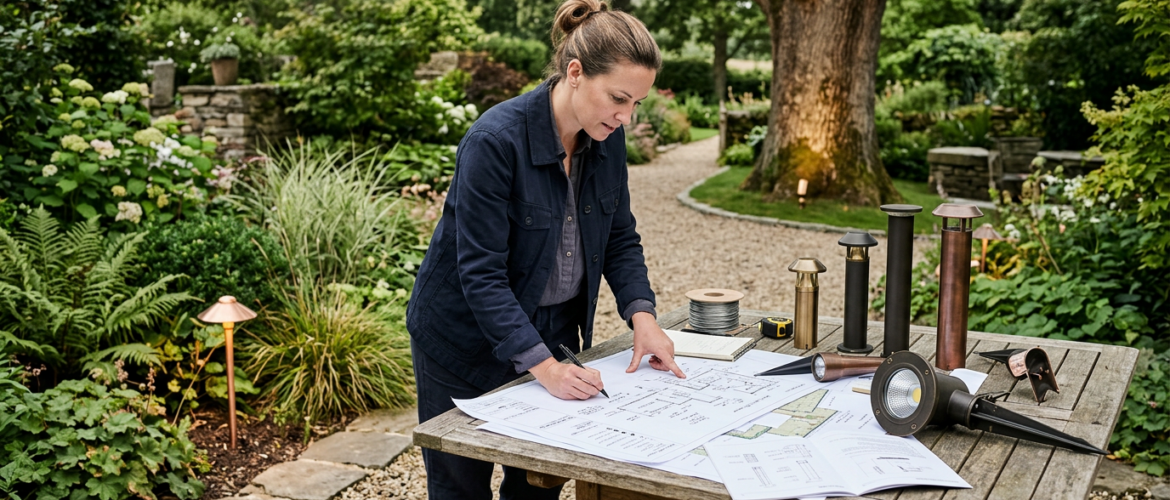
Choosing the right landscape lighting fixtures starts with understanding what each type does and where it performs best. Professional landscape lighting designers use a combination of fixture types to create layered, balanced illumination — and knowing the role of each fixture type helps you make smarter purchasing decisions whether you’re a contractor, designer, or homeowner tackling a DIY install.
This guide covers the six main fixture categories, when to use each, and how to select the right wattage and beam angle for your specific project.
Up Lights: The Workhorse of Landscape Lighting
Up lights (also called spot lights or accent lights) are ground-mounted fixtures that aim light upward. They are the most versatile and commonly used fixture in landscape lighting, accounting for roughly 40-60% of fixtures in a typical residential or commercial design.
Best Uses for Up Lights
- Tree uplighting — Position at the base of the trunk, angled up into the canopy. Use a narrow beam (10-25°) for tall, columnar trees and a wider beam (35-60°) for broad canopy trees like oaks and maples.
- Architectural facade lighting — Place 12-18 inches from the wall, angled up to graze the texture of stone, brick, or stucco. This technique highlights material texture and creates dramatic vertical planes of light.
- Specimen plant accent — A single up light focused on a feature plant, sculpture, or rock creates a focal point that draws the eye.
Choosing Beam Angle for Up Lights
| Beam Angle | Spread at 10 ft | Best For |
|---|---|---|
| 10° (Spot) | ~2 ft wide | Tall narrow trees, flagpoles, columns |
| 25° (Narrow Flood) | ~4.5 ft wide | Medium trees, architectural columns |
| 40° (Flood) | ~7 ft wide | Broad trees, wide facades, large shrubs |
| 60° (Wide Flood) | ~11.5 ft wide | Wall washing, wide canopy trees, hedges |
Path & Area Lights: Safe, Inviting Walkways
Path and area lights are post-mounted fixtures that cast light downward in a circular or semi-circular pattern. They serve two purposes: safety (illuminating walking surfaces to prevent trips and falls) and aesthetics (creating rhythm and visual flow along pathways).
Best Uses for Path Lights
- Walkways and sidewalks — Space fixtures 8-10 feet apart on alternating sides for natural, even coverage
- Garden borders — Line planting beds with low-profile path lights to define edges and illuminate flowering plants at night
- Driveway borders — Taller path lights (24″+) provide wayfinding along driveways and parking areas
- Patio and deck perimeters — Soft ambient lighting around outdoor living areas creates a welcoming atmosphere
Selecting Path Light Height
Path lights typically range from 12 inches to 30 inches tall. Shorter fixtures (12-18″) create intimate, close-range pools of light ideal for garden beds and residential walkways. Taller fixtures (22-30″) cast wider pools suited for commercial walkways and broader landscape areas. Match the fixture height to the scale of the space — a 30-inch fixture looks proportional along a wide commercial walkway but can feel oversized on a narrow garden path.
In-Grade & Well Lights: Invisible Fixtures, Visible Impact
Well lights (also called in-grade lights) install flush with the ground surface, making the fixture itself invisible. Light appears to emerge directly from the earth — a dramatic effect that’s impossible to achieve with any other fixture type.
Best Uses for Well Lights
- Large tree uplighting — When you want powerful uplighting without a visible fixture at the tree base
- Architectural wall grazing — Installed in concrete or pavers next to a wall for dramatic vertical light
- Driveway and pathway in-grade markers — Flush-mounted lights embedded in pavers or concrete provide subtle wayfinding
- Water feature illumination — Underwater-rated well lights can illuminate fountains, ponds, and pool surrounds
Installation Considerations
Well lights require more planning during installation because they’re set in the ground permanently. Ensure proper drainage around the fixture housing to prevent water pooling, and use only fixtures rated for direct burial. FX Luminaire well lights include sealed stainless steel housings with tempered glass lenses designed for long-term in-ground performance.
Down Lights: Moonlighting and Canopy Effects
Down lights mount in trees, under eaves, on pergolas, or on structures to cast light downward. The most popular technique — moonlighting — involves mounting fixtures high in mature trees to simulate natural moonlight filtering through branches, creating dappled shadow patterns on the ground below.
Best Uses for Down Lights
- Moonlighting — Mount 20-30 feet high in tree canopies with a wide beam (40-60°) aimed straight down
- Task lighting for outdoor kitchens and dining areas — Mount under pergola beams or eave soffits
- Security and safety — Illuminate dark corners, side yards, and entry points from above
- Grazing and silhouetting — A down light behind a plant or sculpture creates a silhouette against a wall
Hardscape Lights: Integrated Into Stone and Masonry
Hardscape lights are compact fixtures designed to be permanently installed into walls, steps, pillars, seat walls, and other built structures. Unlike surface-mounted fixtures, hardscape lights become part of the architecture itself — they’re recessed or mortared into the structure during or after construction.
Best Uses for Hardscape Lights
- Step and stair risers — Illuminate treads for safety on outdoor stairs and grade changes
- Retaining walls — Cast light along the base or cap of retaining walls to highlight stone texture
- Outdoor kitchen counters and seat walls — Recessed lights under countertop overhangs and in seat wall faces
- Column and pillar caps — Uplight from pillar tops for dramatic vertical accents
Bollard Lights: Freestanding Wayfinding
Bollard lights are freestanding post fixtures that provide both illumination and visual boundary markers along pathways, driveways, and property borders. They are taller and more substantial than path lights, making them appropriate for commercial properties, HOA common areas, and wide residential walkways where a larger-scale fixture is needed.
How to Select the Right Wattage
Modern LED landscape lighting fixtures use far less wattage than the halogen fixtures they replaced. Here’s a practical wattage guide for LED fixtures:
| Application | LED Wattage | Lumens |
|---|---|---|
| Small shrub accent | 2-4W | 100-250 |
| Medium tree uplighting | 5-8W | 300-600 |
| Large tree uplighting | 9-15W | 700-1200 |
| Path lighting | 2-4W | 100-300 |
| Architectural wall wash | 8-15W | 500-1200 |
| Moonlighting (high mount) | 5-10W | 400-800 |
| Hardscape step light | 1-3W | 50-200 |
Pro tip: Start with lower wattage and increase only if needed. One of the most common mistakes in landscape lighting is over-lighting — too much light creates harsh, unflattering pools and eliminates the shadows and contrast that make good lighting design interesting.
Color Temperature: Warm vs. Cool
Color temperature is measured in Kelvin (K) and determines the “warmth” or “coolness” of the light:
- 2700K (Warm White) — The industry standard for residential landscape lighting. Creates a warm, inviting amber tone similar to candlelight. Flattering to skin tones and natural materials.
- 3000K (Neutral Warm) — Slightly cooler than 2700K, popular for contemporary and commercial designs. Still warm but with a slightly crisper, more modern feel.
- 4000K+ (Cool White) — Used primarily for security lighting and commercial/industrial applications. Creates a stark, bluish tone that’s functional but less aesthetically pleasing for residential landscapes.
For most residential and hospitality landscape lighting, 2700K is the recommended standard. FX Luminaire fixtures are available in 2700K and 3000K, and ZDC-equipped fixtures allow you to adjust color temperature wirelessly.
Planning Your Fixture Mix
A well-designed landscape lighting system typically uses this approximate fixture ratio:
- 40-50% up lights — Tree, plant, and architectural accent lighting
- 20-30% path lights — Walkway and area illumination
- 10-15% specialty fixtures — Hardscape, well lights, down lights
- 5-10% accessories — Transformers, wire, connectors, controllers
For a typical residential front yard lighting project (5-8 trees, 60 feet of walkway, front facade), you might use: 5-6 up lights, 6-8 path lights, 2-3 hardscape or down lights, and a 150-300W transformer. Browse our FX Luminaire lighting kits for pre-configured packages that include fixtures, wire, and a transformer.
Frequently Asked Questions
How many landscape lighting fixtures do I need?
A typical residential front yard uses 12-20 fixtures. A full-property design (front, back, and sides) may use 30-50+ fixtures. The key is quality of placement, not quantity — a few well-positioned fixtures create a more dramatic effect than many poorly placed ones.
What is the best landscape lighting for trees?
Up lights are the most popular choice for tree lighting. Position the fixture 6-12 inches from the trunk, angled into the canopy. For small to medium trees, a single up light is sufficient. Large trees may benefit from two fixtures on opposite sides. Browse our up lights collection for fixtures ranging from compact accent lights to high-output commercial models.
Should I use low voltage or line voltage landscape lighting?
Low voltage (12V) is the standard for residential and most commercial landscape lighting. It’s safer (no risk of electrical shock), doesn’t require a licensed electrician in most areas, and offers a wider selection of fixtures. Line voltage fixtures (120V) are used when higher light output is needed for large commercial properties, parking areas, or sports lighting.
How far apart should path lights be spaced?
Space path lights 8-10 feet apart for even coverage along walkways. Stagger them on alternating sides of the path rather than lining them up symmetrically — this creates a more natural, professional look. For wider paths, increase spacing to 10-12 feet.
Can I install landscape lighting myself?
Yes. Low-voltage landscape lighting is one of the most accessible outdoor improvement projects for homeowners. The 12V system is safe to handle without an electrician. You’ll need a transformer, landscape wire, waterproof connectors, and your chosen fixtures. For a step-by-step guide, see our complete landscape lighting wire and accessories selection.
Need the full system? For Pro-Trade transformers, path lights, ledge lights, wiring and complete low-voltage kits, visit LowVoltageLandscapingLighting.com. The Pro-Trade line is contractor-grade, competitively priced, and ships free across the USA.